
Digital marketing used to be described as a traffic problem. If a company could attract enough visitors, collect enough leads, and buy enough impressions, growth would follow. That traditional digital marketing model is now incomplete.
Today’s audiences are highly selective, online platforms are increasingly crowded, evolving privacy regulations restrict traditional tracking methods, and buyers thoroughly evaluate promises prior to contacting sales. A polished advertisement may earn a click, but it cannot by itself create confidence. A large email list may look impressive, but it does not guarantee engagement. Even a high-ranking page can fail if it does not answer the visitor’s real question.
The strongest digital marketing programs therefore do more than distribute messages. They build a connected experience that helps the right people discover a brand, understand its value, believe its promises, take a useful next step, and remain satisfied after purchase.
This is a trust-first, full-funnel approach to modern digital marketing. It combines strategy, content, search, social media, email, advertising, conversion design, analytics, and customer experience into one operating system. Each channel has a role, but no channel is expected to carry the entire business.
1. Start with a Clear Growth Thesis for Digital Marketing Strategies
Many marketing plans begin with tactics: publish three posts a week, run a search campaign, redesign the website, or start a newsletter. Tactics are useful only when they support a clear explanation of how the business expects to grow.
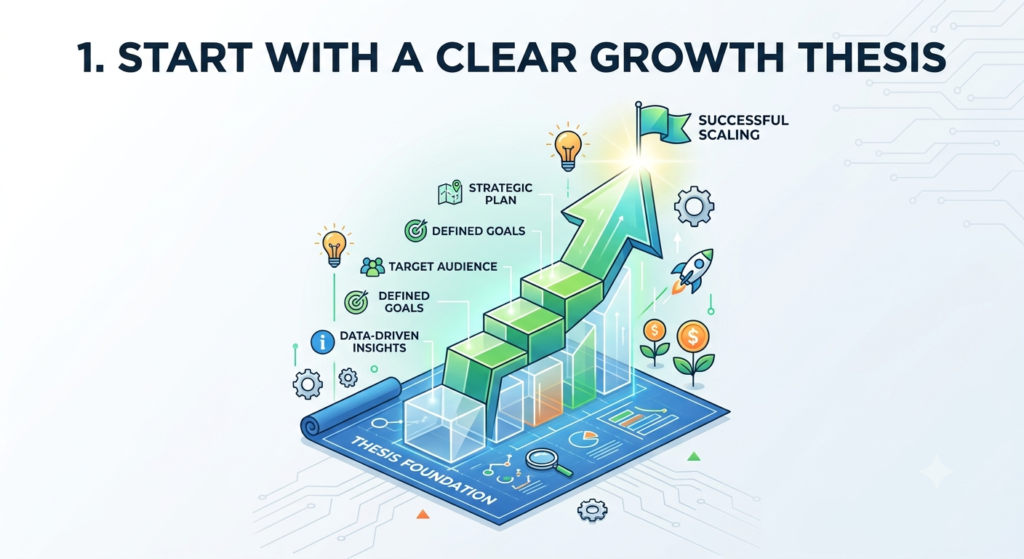
A growth thesis is a concise statement connecting audience, problem, promise, mechanism, and outcome. For example:
We help independent professional firms reduce the time required to generate qualified proposals by giving them a simple, repeatable content and follow-up system. We will reach them through educational search content, industry partnerships, and targeted email, then convert them with practical templates and a low-friction consultation process.
This statement does several jobs. It identifies a specific audience instead of “everyone.” It names a meaningful problem instead of a vague desire. It describes the promised change. It suggests the channels most likely to reach that audience. Finally, it implies a conversion path.
Without a growth thesis, teams often mistake activity for progress. They measure posts published, impressions delivered, or website sessions generated even when those numbers do not move revenue. A well-defined thesis provides teams with a clear benchmark to evaluate and prioritize their key initiatives.
A useful growth-thesis template
Complete These Sentences
We serve: Small businesses, startups, and local brands that want to improve their online presence and attract more customers through digital marketing.
They struggle with: Low online visibility, reaching the right audience, generating quality leads, and converting potential customers into sales.
They want: Better brand awareness, increased website traffic, more customer inquiries, and measurable business growth.
We are different because: We focus on practical digital marketing strategies tailored to each business’s goals, target audience, and budget.
We will reach them through: Google Search, SEO, social media platforms, relevant content, and other digital marketing channels where potential customers discover and evaluate businesses.
The Purpose Is to Make Smarter Digital Marketing Decisions
Marketing is not just about coming up with a catchy slogan or creating an attractive campaign. It is about developing a digital marketing strategy that helps the right people find solutions to their actual problems. Every campaign needs a clear objective. If an idea does not address the audience’s needs or help them reach their goals, it may be more suitable for another marketing approach.
Identify the Right Target Audience
Customers differ in their needs, budgets, and expectations. For instance, a digital marketing specialist might work with local businesses, startups, service providers, and established companies. A local shop may want to bring more people through its doors, while a startup may be looking to increase brand awareness and generate potential leads. Each business has its own challenges, priorities, and preferred online channels.
Begin by focusing on people who need your services, can be reached through the appropriate digital marketing channels, and are prepared to invest in solutions that benefit their business. Understanding these customers helps you create useful content, communicate the value of your services, and plan marketing campaigns that appeal to the right people.
2. Build a Customer Insight System for Effective Digital Marketing Strategies, Not a One-Time Persona

Traditional personas often become fictional biographies: “Marketing Mary is 34, enjoys yoga, ## Understanding Customer Buying Decisions
Customer profiles often include details such as age, hobbies, and interests. These details can be useful, but they do not always explain what makes someone choose one product or service over another in digital marketing.
To understand buying decisions, businesses need to know what problems customers face, where they look for answers, what other options they consider, and what influences their final choice.
Understand the Customer Journey
Customers need different information depending on how far they have progressed in making a decision. A prospect who is early in the decision-making process rarely responds well to a direct sales pitch. They may first need to understand what is wrong, how it affects them, and whether they need to find a solution through digital marketing channels.
Create Message Pillars Around Customer Needs
Look at the questions, concerns, and needs customers mention most often. Use these findings to develop three to five main messages that explain what your business offers and what customers can expect from it.
For example, a digital marketing and cybersecurity consultancy might focus on these five areas:
Affordable, practical security and digital marketing solutions for teams with limited resources.
Simple explanations of security risks without creating unnecessary fear.
Finding serious security weaknesses before they cause greater damage.
Recommendations based on evidence that business leaders can understand.
Continued support after the initial security assessment and digital marketing setup.
These message pillars help a business maintain a consistent message across its digital marketing channels. Different posts and campaigns can address different topics while staying relevant to the business and its customers. They also help the team decide whether a new content idea fits the overall digital marketing strategy.
3. Design the Funnel Around Customer Progress with Digital Marketing Strategies
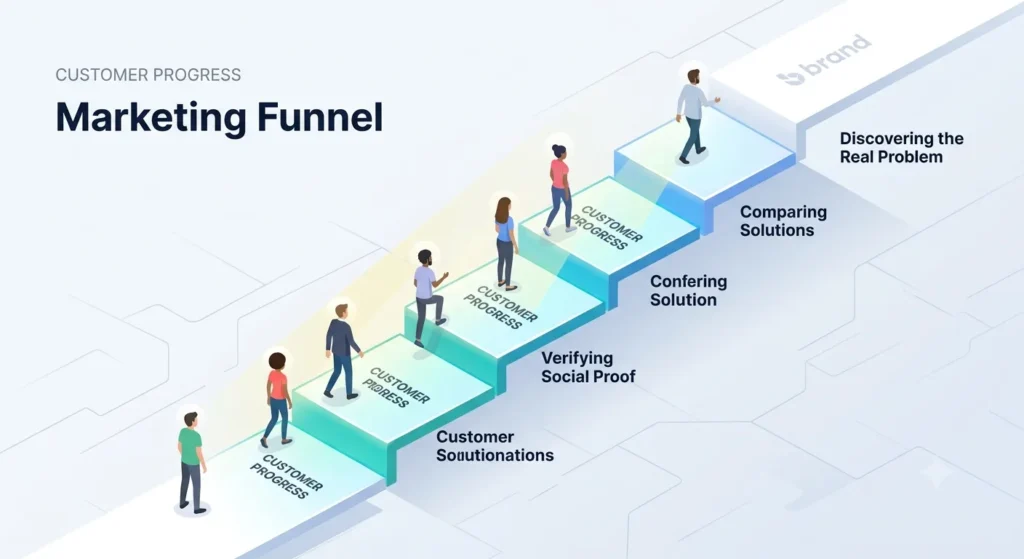
Buyers rarely move through a marketing funnel in a strictly linear progression. Customers loop, skip steps, return after months, and enter through different channels. Still, funnel thinking is useful when it describes progress rather than merely exposure.
A practical full-funnel digital marketing model has four stages:
Stage one: Recognition
At this stage, people are identifying a problem, desire, or opportunity. They may not know the category or your company. Effective digital marketing clearly defines the challenge, simplifies complex details, and offers audiences a compelling motive to engage.
Examples include educational articles, short videos, trend analysis, checklists, community discussions, and explanatory social posts.
Stage two: Consideration
At this point, audiences recognize their core issue and begin actively investigating potential solutions through digital marketing channels. They want to know what works, what it costs, how long it takes, and which option fits their situation.
Useful assets include comparison guides, webinars, case studies, product explainers, calculators, expert interviews, sample plans, and detailed FAQs.
Stage three: Decision
The prospect is evaluating whether to choose your offer. Key considerations often include pricing, rollout requirements, perceived risks, system integration, organizational buy-in, timeline, and projected ROI.
Stage Four: Success and Advocacy
The customer relationship does not conclude at payment. Delivering customer success relies on comprehensive onboarding, ongoing education, prompt customer service, product usage prompts, timely renewals, referral programs, and an active user community.
When clients experience tangible outcomes, they are far more inclined to renew subscriptions, upgrade plans, leave reviews, recommend your brand, and feature in digital marketing promotional efforts. Hence, customer retention and customer acquisition are deeply interconnected rather than isolated processes. Prioritizing long-term client satisfaction substantially enhances commercial viability while boosting brand trust in the market.
Aligning Your Call to Action with the Buyer Journey
A frequent digital marketing conversion error involves demanding high commitment prematurely. First-time site visitors often prefer downloading a helpful guide rather than booking an immediate sales call. Conversely, a repeat visitor who has evaluated pricing structures and integration details is much more prepared to book a consultation.
Use calls to action that match customer readiness:
Recognition: read, watch, explore, subscribe, or save.
Consideration: download, compare, attend, calculate, or ask.
Decision: initiate, schedule, submit a request, purchase, or consult a specialist.
Success: activate, learn, review, renew, refer, or upgrade.
An effective call to action does not necessarily need to be overly forceful. It is the next step that creates meaningful progress for both customer and business.
4. Build a Content Framework That Delivers Long-Term Growth Through Digital Marketing Strategies
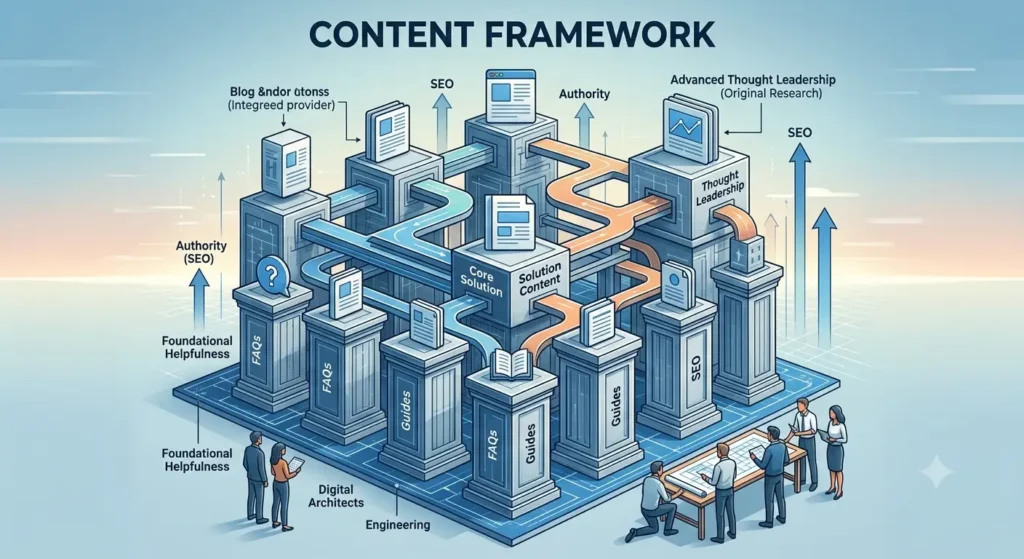
Digital marketing content performs best when it is treated as an operating system rather than a stream of disconnected posts. The system should turn customer questions into useful assets, distribute those assets where audiences pay attention, and reuse successful ideas in multiple formats.
Use the problem-to-proof content structure
A strong digital marketing content program usually needs five types of material:
Problem content: Helps the audience recognize and understand an issue.
Process content: Outlines actionable steps to address or resolve the problem.
Perspective content: Presents a unique viewpoint, strategic lens, or original methodology.
Proof content: Demonstrates that the method or offer works.
Action content: Makes the next step clear and easy.
Numerous businesses continuously share problem-focused posts yet seldom offer concrete evidence or clear next steps. Others publish promotional content before earning attention. Balance matters.
Structuring Your Content Collection
Manage your digital marketing content repository much like a balanced investment account, pairing quick audience interaction with long-term utility. Timeless evergreen assets address persistent inquiries, drawing continuous audience interest for months or years. It includes tutorials, glossaries, frameworks, templates, and foundational guides.
Timely content responds to current events, industry changes, cultural conversations, or seasonal demand. It can create fast attention, but its lifespan is shorter.
Original research creates authority by presenting data, observations, experiments, or customer patterns that others can reference. Although demanding greater resources, it generates backlinks, speaking opportunities, and media coverage for your digital marketing presence.
Customer proof connects promises with outcomes. Case studies are strongest when they explain the starting situation, the decision process, the work performed, the obstacles, and the measurable or observable result.
Utility content helps people complete a task. Interactive calculators, cheat sheets, action lists, templates, and audit tools often deliver greater value than standard blogs by directly streamlining user effort.
troubleshooting, reporting, or a request for a benchmark. Content must fulfill the core objective driving the user’s query. A useful digital marketing content brief includes: • The audience and situation.
The particular problem statement or user task at hand.
The primary insight the reader should gain.
Information gaps present in competitor content.
Evidence, examples, or experience to include.
The intuitive call to action or subsequent phase.
A metric or method to measure content effectiveness. Make original content genuinely original
Originality is not achieved by changing a few words in an existing article. It comes from using your own reasoning, examples, data, interviews, experiments, and point of view. A practical originality checklist: • Share direct observations gathered through execution or customer inputs.
Explain a trade-off instead of presenting a one-sided claim.
Use realistic scenario examples that highlight operational limits and constraints.
Highlight scenarios or edge cases where recommendations might differ.
Offer a structured model that guides the user toward an informed choice.
Reference third-party data where essential, but express the analysis entirely in your voice.
Audit the final draft to remove fluff, buzzwords, and unsubstantiated claims. The reader should leave with something they can use, not merely with the impression that the article sounds professional.
5. Treat Search Visibility as Helpfulness at Scale in Digital Marketing Strategies
SEO is frequently oversimplified as a mere competition for search rankings. A better definition is making the right answer easy for the right person to discover, understand, trust, and act upon within a digital marketing strategy.
Build topic depth through connected resources
A single article rarely establishes meaningful authority on a broad subject. Organize related resources into a digital marketing topic system:
A core pillar asset covering the overarching theme.
Supporting articles that answer specific questions.
Practical examples and templates.
Evaluation materials and buyer selection guides.
Product or service pages connected to the problems discussed.
Link these resources intentionally. An individual reviewing entry-level content ought to seamlessly transition into an in-depth breakdown. Someone reading a decision guide should be able to reach proof and an appropriate offer.
Enhance On-Page User Experience
Even factually precise content underperforms when user interface and usability are weak. Prioritize:
An opening that confirms the page is relevant.
Informative subheadings paired with concise paragraphs.
Examples, visuals, tables, or steps where they improve understanding.
Rapid load speeds optimized for seamless smartphone consumption.
Obvious but non-disruptive navigation.
Refreshed information accompanied by clear timestamps for time-sensitive topics.
Author or organization context that supports credibility.
Search visibility is not a substitute for quality. It is a digital marketing distribution advantage for quality.
Prepare for answer-oriented discovery
People increasingly encounter information through summaries, assistants, video platforms, communities, and search results that answer questions directly. Consequently, clear messaging becomes even more vital in digital marketing.
Write definitions that stand on their own. Break complex explanations into logical sections. Use descriptive language rather than vague branding. Include the conditions, limits, and steps behind a recommendation. If your content is the clearest explanation available, it has more chances to be referenced across different discovery environments.
Evaluate Search Performance Beyond Basic Clicks
Look beyond surface-level clicks and impressions by auditing:
Audience engagement segmented according to user intent.
Immediate or multi-touch conversion pathways driven by organic traffic.
Retention metrics and repeat user activity.
Sign-ups or inquiries from specific digital marketing topic clusters.
Branded query volume following initial audience discovery.
Leads or sales influenced by non-branded discovery.
A low-traffic page driving high-quality leads holds significantly greater value than a viral article drawing irrelevant audiences.
6. Use Social Media for Distribution, Conversation, and Evidence in Digital MarketingStrategies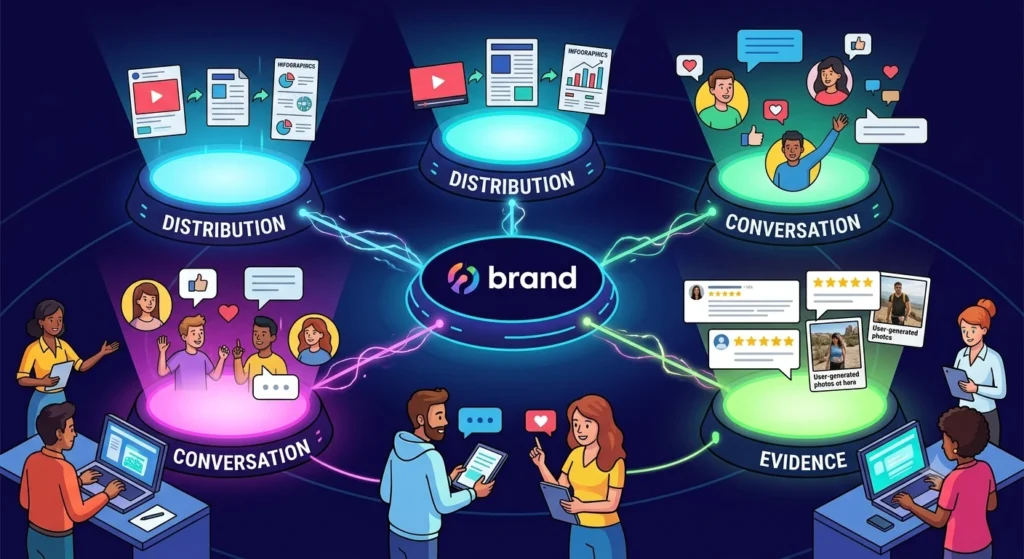
Social media is not one channel. Each platform has its own behavior, format, audience expectations, and relationship between discovery and trust. The goal is not to copy the same post everywhere. The goal is to adapt a useful idea to the way people use each environment in digital marketing.
Give each platform a job
One platform may be best for professional credibility, another for visual demonstration, another for community discussion, and another for short educational entertainment. Define the job before choosing the content format.
A platform role in digital marketing could be:
Reach new audiences through practical insights.
Showcase product features and real-time execution methods.
Foster active dialogue and networking within industry circles.
Connect followers directly with company founders and subject experts.
Distribute customer stories and proof.
Drive qualified people to a deeper resource.
If every platform is expected to generate immediate sales, the content will become repetitive and overly promotional.
Design for native participation
Audiences interact uniquely depending on whether content is an announcement, an inquiry, a live walkthrough, or a group call-to-action. Use platform-native formats such as short explanations, polls, live sessions, carousels, behind-the-scenes process notes, response videos, and public answers to recurring questions.
The most valuable social signal in digital marketing is often not a like. Instead, high-value engagement appears as insightful feedback, specific inquiries, bookmarked posts, colleague mentions, or contextual resharing.
Develop recognizable points of view
Build a response habit
Social media rewards participation. Establish a realistic operating rhythm:
Respond with substance rather than generic thanks.
Invite useful customer experiences.
Escalate complaints quickly and respectfully.
Capture recurring questions for future content.
Credit people whose ideas influence your work.
A thoughtful response can become a public demonstration of the brand’s competence and character.
Make Email a Permission-Based Relationship Channel
Email remains powerful because it is a direct, repeatable digital marketing strategy to help people who have chosen to hear from you. It becomes weak when every message is a sales announcement or when the list is treated as a static database.
Earn the subscription
A visitor should understand what they will receive, how often they will receive it, and why it is worth sharing an email address. A vague promise such as “join our newsletter” is rarely compelling.
Stronger invitations describe a benefit:
A monthly set of templates for improving customer retention.
Brief, timely briefings on critical market trends that affect daily business operations.
A guided course that helps the reader complete a specific project.
Deliver the promised value quickly. The welcome sequence should help subscribers understand what to expect and take one useful action.
Segment by need and behavior
Not every subscriber has the same problem. Segment according to meaningful differences such as audience type, product interest, lifecycle stage, past purchase, content engagement, or stated preference.
Avoid excessive complexity. A small business may need only a few useful segments, not dozens of labels that nobody maintains. The aim is relevance, not administrative sophistication.
Use a balanced email mix
A healthy digital marketing email program may include:
Educational messages that teach or interpret.
Curated messages that save subscribers time.
Product messages that explain a relevant offer.
Onboarding messages that help new customers succeed.
Re-engagement messages that respect inactive subscribers.
The right balance depends on the business and the audience. The principle is simple: every promotional message should be more effective because previous messages have created trust and usefulness.
Respect attention and consent
Use clear consent, honest subject lines, easy preference controls, and a visible unsubscribe path. Remove or suppress addresses that are persistently inactive when appropriate. A smaller engaged list is often more valuable than a large list that damages deliverability and creates false confidence.
Email is permission, not ownership.
7. Make Email a Permission-Based Relationship Channel in Digital Marketing Strategies

Email remains powerful because it is a direct, repeatable way to help people who have chosen to hear from you. It becomes weak when every message is a sales announcement or when the list is treated as a static database.
Earn the subscription
A visitor should understand what they will receive, how often they will receive it, and why it is worth sharing an email address. A vague promise such as “join our newsletter” is rarely compelling.
Stronger invitations describe a benefit:
- A monthly set of templates for improving customer retention.
- Short alerts when important industry changes affect operations.
- A guided course that helps the reader complete a specific project.
Deliver the promised value quickly. The welcome sequence should help subscribers understand what to expect and take one useful action.
Segment by need and behavior
Not every subscriber has the same problem. Segment according to meaningful differences such as audience type, product interest, lifecycle stage, past purchase, content engagement, or stated preference.
Avoid excessive complexity. A small business may need only a few useful segments, not dozens of labels that nobody maintains. The aim is relevance, not administrative sophistication.
Use a balanced email mix
A healthy program may include:
- Educational messages that teach or interpret.
- Curated messages that save subscribers time.
- Product messages that explain a relevant offer.
- Onboarding messages that help new customers succeed.
- Re-engagement messages that respect inactive subscribers.
The right balance depends on the business and the audience. The principle is simple: every promotional message should be more effective because previous messages have created trust and usefulness.
Respect attention and consent
Use clear consent, honest subject lines, easy preference controls, and a visible unsubscribe path. Remove or suppress addresses that are persistently inactive when appropriate. A smaller engaged list is often more valuable than a large list that damages deliverability and creates false confidence.
Email is permission, not ownership.
8. Use Paid Media to Accelerate Learning, Not Hide Weakness in Digital Marketing Strategies

Paid campaigns rapidly expand brand reach, yet they fail to fix long-term flaws like vague value propositions, insufficient credibility, or friction in customer journey. Paid media works best when it accelerates a digital marketing system that already has a coherent message and conversion path.
Separate demand capture from demand creation
Capturing existing demand engages prospects actively seeking immediate answers or products. Search advertising, comparison placements, retargeting, and marketplace advertising often serve this purpose.
Demand creation introduces a problem, category, or brand to people who may not be actively searching. Video, social, display, sponsorships, and creator partnerships can contribute here in a broader digital marketing strategy.
The creative, targeting, and measurement should reflect the difference. Users intentionally searching for solutions prioritize clear messaging and quick access. A person encountering a new category may first need education and proof.
Test variables that matter
Do not call a campaign a test if every important variable changes at once. Formulate a clear assumption and evaluate a single key variation whenever feasible:
Audience or context.
Problem framing.
Promotional value proposition or buyer hook.
Visual layout or ad design style.
Landing-page promise.
Conversion prompt or action statement.
Validation method or trust signal.
Run tests long enough to collect useful evidence, while watching for obvious issues such as broken tracking, irrelevant traffic, or an unacceptable cost. A test should produce a learning decision, not merely a winner for a digital marketing dashboard.
Evaluate incrementality carefully
Some conversions would have happened without advertising. This is especially true for branded search, retargeting, and audiences already familiar with the company. Benchmark ad-targeted segments against unexposed control groups whenever feasible, analyze regional or temporal trends, and integrate digital marketing ad-network analytics with internal CRM records.
A reported return is not automatically an incremental return.
Protect the post-click experience
A relevant advertisement can still fail when it leads to a generic homepage. Ensure the destination landing page directly reflects the core value offered in your advertisement. Repeat the key benefit, explain the next step, show evidence, answer objections, and remove unnecessary friction.
Paid traffic is rented attention. The landing page determines whether that attention becomes useful progress in your digital marketing funnel.
Improve Conversion by Reducing Uncertainty
Optimizing conversions avoids aggressive tactics; instead, it focuses on simplifying comprehension and execution for sound customer choices.
Find the real friction
Look beyond analytics. Numbers can show where people leave, but not always why. Combine quantitative and qualitative evidence:
Session recordings or usability observation where appropriate.
Customer support questions.
Common deal resistance and prospect pushbacks.
Embedded feedback widgets and web polls.
Direct outreach to users who abandoned the purchase process.
Reviews of competitor experiences.
Common sources of friction include unclear pricing, excessive form fields, confusing language, lack of proof, weak mobile usability, unexpected requirements, and uncertainty about what happens after submission.
Use a clear value proposition
A useful value proposition answers three questions quickly:
What is this?
Who is it for?
Why should the visitor care now?
Specificity creates confidence. Vague statements like “Elevate your enterprise with cutting-edge tools” offer zero meaningful context. “Automate weekly client reporting in one afternoon, without rebuilding your existing workflow” gives a reader something to evaluate.
Place proof near the claim
Testimonials are more useful when they are specific and connected to the relevant promise. A statement about saving time belongs near the explanation of how time is saved. A result claim should include context when possible: the customer type, starting condition, timeframe, or method.
Proof can include customer quotes, case studies, demonstrations, transparent methodology, expert credentials, guarantees, usage numbers, security information, or third-party recognition. Use only evidence that is accurate and permitted for use.
Design the smallest reasonable next step
Request solely the data strictly essential for the immediate step. If a visitor is downloading a guide, a short form may be appropriate. If a salesperson needs qualification details, explain why those details matter.
9. Improve Conversion by Reducing Uncertainty with Digital Marketing Strategies
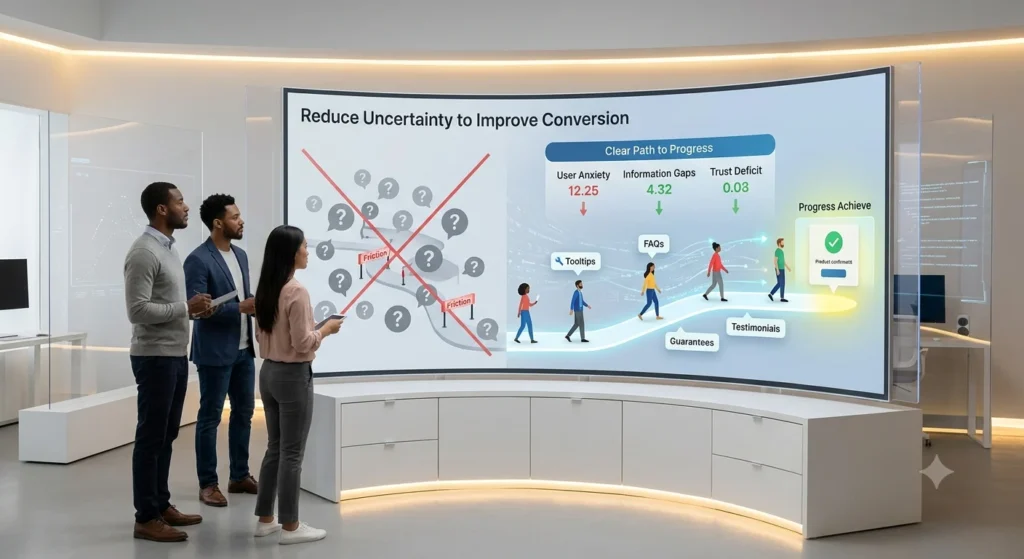
Optimizing conversions avoids aggressive tactics; instead, it focuses on simplifying comprehension and execution for sound customer choices.
Find the real friction
Look beyond analytics. Numbers can show where people leave, but not always why. Combine quantitative and qualitative evidence:
- Session recordings or usability observation where appropriate.
- Customer support questions.
- Common deal resistance and prospect pushbacks.
- Embedded feedback widgets and web polls.
- Direct outreach to users who abandoned the purchase process.
- Reviews of competitor experiences.
Common sources of friction include unclear pricing, excessive form fields, confusing language, lack of proof, weak mobile usability, unexpected requirements, and uncertainty about what happens after submission.
Use a clear value proposition
A useful value proposition answers three questions quickly:
What is this?
Who is it for?
Why should the visitor care now?
Specificity creates confidence. Vague statements like “Elevate your enterprise with cutting-edge tools” offer zero meaningful context. “Automate weekly client reporting in one afternoon, without rebuilding your existing workflow” gives a reader something to evaluate.
Place proof near the claim
Testimonials are more useful when they are specific and connected to the relevant promise. A statement about saving time belongs near the explanation of how time is saved. A result claim should include context when possible: the customer type, starting condition, timeframe, or method.
Proof can include customer quotes, case studies, demonstrations, transparent methodology, expert credentials, guarantees, usage numbers, security information, or third-party recognition. Use only evidence that is accurate and permitted for use.
Design the smallest reasonable next step
Every additional field, decision, or piece of effort can reduce completion. Request solely the data strictly essential for the immediate step. If a visitor is downloading a guide, a short form may be appropriate. If a salesperson needs qualification details, explain why those details matter.
10. Measure the Business, Not Just the Marketing Activity in Digital Marketing Strategies

Measurement should help people make better decisions. A report full of numbers can still fail if it does not show what to do next in a digital marketing strategy.
Use a measurement hierarchy Business outcomes include revenue, gross profit, qualified pipeline, retention, repeat purchase, customer lifetime value, and contribution margin. Customer outcomes include activation, successful use, satisfaction, renewal, referral, and time to value. Digital marketing metrics encompass high-intent leads, sales conversion percentages, customer acquisition costs, newsletter interaction rates, content-driven deal pipeline, and repeat site traffic. Activity indicators include reach, impressions, clicks, publishing volume, and follower growth. Activity indicators can diagnose performance, but they are not substitutes for business outcomes. Keep the hierarchy visible so a rise in reach does not distract from a decline in qualified demand.
Define the unit economics At minimum, understand:
Average order value or average contract value.
Gross profit percentage.
Customer acquisition expense (CAC).
Prospect-to-buyer transition percentage.
Client retention levels and re-order frequencies.
Payback period.
Estimated lifetime value, with assumptions clearly stated.
Such metrics establish budget expansion limits for your digital marketing campaigns. An acquisition campaign showing high upfront costs can still prove highly profitable if long-term subscriber retention remains strong. A cheap lead source may be harmful if leads never become customers.
Use attribution with humility Attribution frameworks provide helpful analytical perspectives rather than absolute facts. A customer may encounter a social post, search for the brand later, read an article, receive an email, speak with sales, and then convert. Assigning all credit to the final click hides the role of earlier digital marketing touchpoints. Assigning equal credit to everything can be equally unhelpful.
Use multiple views:
Traffic origin and digital marketing initiative performance logs.
Customer-level journey analysis.
Assisted conversion patterns.
User group behavior tracking over time.
Controlled experiments where feasible.
Feedback from sales and customer teams. The objective is not to discover one magical number. It is to make decisions with less uncertainty.
Create a simple learning loop Every month or campaign cycle, answer: What did we expect? What happened? What surprised us? What underlying factors drove the variance? What will we change? What will we test next in our digital marketing plan? Document the answers. Eventually, an organization’s collective institutional knowledge transforms into a sustainable competitive advantage.
11. Build a Sustainable Marketing Operating System for Digital Marketing Strategies

Even excellent strategy fails when the team cannot execute it consistently. A sustainable operating system defines priorities, ownership, workflows, standards, and review rhythms.
Choose a few strategic bets
A small team cannot optimize every channel. Select one or two primary growth bets and a limited number of supporting activities. For example, a company might focus on search-led education and customer referral while using email for retention and paid media for carefully measured demand capture.
A channel deserves priority when it matches audience behavior, the team can produce useful material for it, and the economics can support it.
Use a repeatable production workflow
A simple workflow may include:
26 Gather customer questions and business priorities.
27 Choose the highest-value topic or experiment.
28 Write a clear brief and define success.
29 Produce the core asset.
30 Review for accuracy, originality, clarity, accessibility, and compliance.
31 Publish and distribute in adapted formats.
32 Engage with responses and collect questions.
33 Measure meaningful outcomes.
34 Update, reuse, or retire the asset.
This process reduces the pressure to invent something from nothing every day.
Establish responsible use of automation and AI
Automation can help with research organization, transcription, drafting variations, reporting, personalization, and repetitive operations. It should not replace human judgment about customer truth, factual accuracy, originality, privacy, or brand responsibility.
Use a review standard:
- Remove invented evidence or unsupported statistics.
- Check for accidental imitation or generic language.
- Ensure a human can stand behind the final message.
Efficiency holds real value only if high quality and customer trust are preserved.
Make collaboration visible
Marketing depends on sales, customer success, product, operations, finance, and leadership. Create shared definitions for a qualified lead, a successful customer, a valid experiment, and an acceptable cost. When teams use different definitions, reporting becomes an argument rather than a tool.
A short weekly review can focus on execution. A monthly review can focus on learning and pipeline. A quarterly review can revisit the growth thesis and strategic bets.
12. Common Digital Marketing Mistakes and Better Alternatives for Digital Marketing Strategies

Mistake one: Chasing every platform
Being present everywhere often produces shallow, inconsistent work. Select platforms aligned with audience habits and internal execution capacity.
Better alternative: Become genuinely useful in one or two environments before expanding.
Mistake two: Confusing visibility with demand
Impressions and followers may grow without producing qualified interest.
Better alternative: Connect awareness metrics to actions, pipeline, revenue, or customer outcomes.
Mistake three: Publishing without a conversion path
A helpful article can build trust, but readers may not know what to do next.
Better alternative: Offer a relevant next step that matches the reader’s stage and intent.
Mistake four: Using generic claims
Words such as innovative, seamless, powerful, and best-in-class are easy to write and difficult to believe.
Better alternative: Show the mechanism, the situation, the evidence, and the result.
Mistake five: Treating all leads equally
A downloaded guide, a pricing request, and a referral from an existing customer represent different levels of intent.
Better alternative: Define lead stages and create appropriate follow-up.
Mistake six: Prioritizing immediate conversions over long-term brand credibility
Urgency tricks, hidden fees, exaggerated scarcity, and aggressive retargeting may produce temporary results while damaging long-term reputation.
Better alternative: Make the offer easy to understand, genuinely useful, and honest about limitations.
Mistake seven: Abandoning a channel too quickly
Some channels require consistent learning before results become visible. Others are simply a poor fit.
Better alternative: Define a reasonable test period, success criteria, and stop conditions before investing heavily.
Mistake eight: Never improving existing assets
Teams often create new content while valuable pages become outdated or difficult to use.
Better alternative: Schedule regular updates, consolidation, internal linking, and conversion improvements.
13. A Practical 90-Day Implementation Plan for Digital Marketing Strategies

A full transformation does not need to happen at once. The following 90-day plan creates a useful foundation.
Days 1–15: Diagnose and focus
- Formulate core business growth hypotheses.
- Identify the primary target market niche.
- Gather qualitative feedback from clients, potential buyers, and internal stakeholders.
- Review current traffic, conversion, retention, and channel performance.
- Identify the three biggest customer questions and three biggest business constraints.
- Map out existing customer pathways from initial awareness through retention.
The output should be a short strategy brief, not a large presentation that nobody uses.
Days 16–30: Build the message and measurement foundation
- Establish core communication themes.
- Clarify the value proposition for key offers.
- Create a basic funnel and lifecycle map.
- Set business, customer, marketing, and activity metrics.
- Fix obvious tracking gaps.
- Review the highest-traffic and highest-value pages for clarity and friction.
- Establish content and campaign review standards.
By phase end, internal teams must gain absolute clarity regarding target messaging, ideal buyer profiles, and key performance benchmarks.
Days 31–60: Publish and improve useful assets
- Create one strong foundational guide.
- Publish several supporting pieces based on real customer questions.
- Produce or refresh minimum one social proof case study.
- Build a welcome email sequence.
- Optimize a high-priority conversion page.
- Adapt the core ideas into platform-appropriate social content.
Prioritize usefulness and learning over volume.
Days 61–90: Connect, test, and refine
- Review performance by audience and intent.
- Compare content-assisted opportunities with direct conversions.
- Execute a controlled split test on landing page elements or core positioning.
- Interview new customers about what influenced their decision.
- Decide which channel or asset deserves more investment.
- Retire, update, or repurpose low-value work.
- Write the next 90-day plan from evidence rather than assumptions.
The objective is not to complete every marketing tactic. It is to create a repeatable learning and growth system.
Conclusion: The Advantage Is Coherence
Digital marketing is not a collection of tricks. It is the coordinated practice of helping people make progress before, during, and after a buying decision.
Highly sustainable marketing engines demonstrate common core traits. High-performing strategies launch with explicit buyer personas and validated expansion logic. Top organizations adopt authentic customer vocabulary over internal corporate jargon. They create content that answers real questions and includes original insight. They treat search and social media as distribution and participation systems, not vanity-score generators. They use email with respect, paid media with discipline, and conversion design to reduce uncertainty. They measure business outcomes while accepting that attribution will never be perfect. Crucially, sustainable models align user acquisition goals with long-term customer retention.
Trust grows when the experience is coherent. The advertisement reflects the landing page. The landing page reflects the offer. The offer matches the customer’s expectations. The onboarding helps the customer achieve the promised result. The result becomes proof that improves future marketing. That coherence is difficult to copy because it is built from many small decisions: an honest claim, a useful example, a clear next step, a timely response, a better question, a repaired broken link, a customer story told accurately, and a team willing to learn from evidence. If you are improving a digital marketing program, do not begin by asking which new channel you should try. Begin by asking: • Whom are we trying to help?
- What progress do they need to make?
- Why should they believe us?
- Which actionable call-to-action adds the most value right now?
- By what metrics will we validate customer success and engagement? Answer those questions clearly, then build the channels around them. In a crowded digital environment, the brands that grow sustainably are rarely the ones shouting the loudest. They are the ones that make the customer’s decision clearer, safer, and more valuable. Author’s Note on OriginalityThis article was written as an original piece for this request. It is not copied from a source or paraphrased from a single existing article. Before publication, verify any market statistics, legal claims, platform policies, or industry-specific statements that you may add, and cite external sources where appropriate. Author Name: Naseel.p
- Website: https://marketingbynaseel.online/